








Is CSGO.NET Legit and Safe? Fairness, Steam and Scam Protection
Trust is easier to evaluate when the controls are visible: Steam-linked accounts, Provably Fair data, Roll-ID verification and direct anti-fraud guidance all matter.
Is CSGO.NET Legit?
CSGO.NET is operated under a published User Agreement that identifies Crystal Future OÜ as the owner and describes account access through Steam, case licensing, inventory handling, payment rules and dispute procedures. That legal framework does not remove the financial risk of case opening, but it gives users concrete terms to review before using the platform.
A useful legitimacy check should focus on verifiable mechanics rather than a generic “safe” label. CSGO.NET publishes a Provably Fair explanation, exposes the values used in its verification flow, provides a Roll-ID check, uses Steam-linked accounts and publishes warnings about fake administrators. Those controls can be inspected directly rather than accepted on trust.
Provably Fair
Client Seed, Server Seed and Nonce are used in the published verification explanation.
Roll-ID check
The fairness interface includes a Roll-ID field for checking completed game data after the relevant seed is revealed.
Steam-linked access
The User Agreement describes Personal Account access through Steam authentication.
How Provably Fair Verification Is Explained
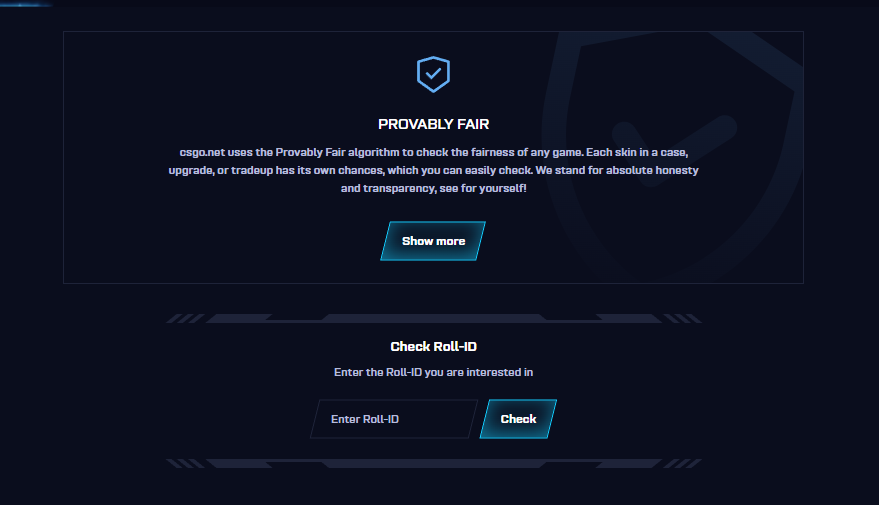
The official fairness material identifies three values: Client Seed, Server Seed and Nonce. The Client Seed is a sequence set by the client, the Server Seed is generated by the server, and the Nonce represents the number of user actions relevant to the game. The system combines these values to generate the result.
The verification instructions state that the Server Seed must be revealed before the completed result can be independently checked. Users can then copy the JSON game data from the Roll-ID verification page and compare it through the published open-source verification process. The value of this system is verifiability: the result can be checked against data that existed before the outcome was displayed.
Beware of Fake CSGO.NET Admins
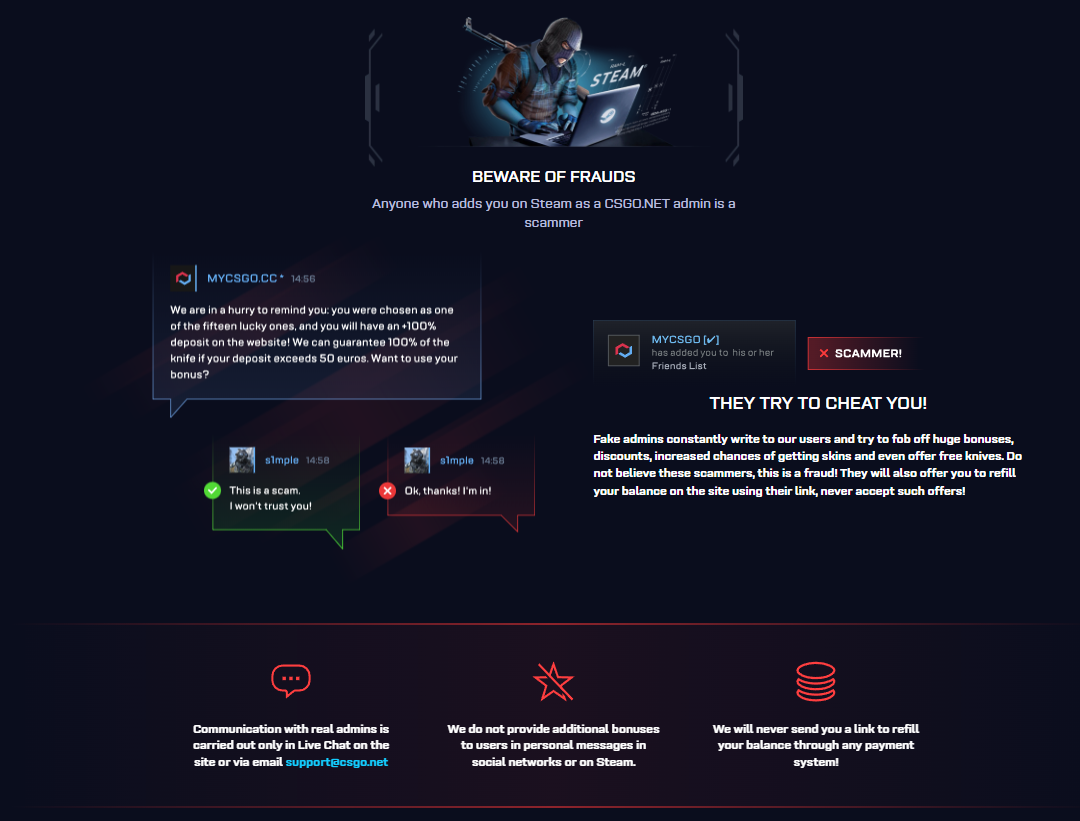
CSGO.NET publishes a direct fraud warning: a person who adds a user on Steam while claiming to be a CSGO.NET administrator should be treated as a scammer. The official material warns against private messages promising large bonuses, discounts, increased chances or free knives in exchange for following a refill link.
Use official support
Contact real administrators through Live Chat on the site or the official support email shown by CSGO.NET.
Ignore private bonus offers
Do not trust personal messages on Steam or social networks promising special bonuses.
Do not follow refill links
The anti-fraud guidance says CSGO.NET will not send a private link asking a user to refill balance through another payment system.
Account security also depends on keeping Personal Account credentials private. The User Agreement places responsibility on the user to protect access information and not grant account access to third parties.
Account and Payment Security Signals
The User Agreement states that payment processing for bank cards uses a processing center that complies with PCI DSS requirements. It also places responsibility on users to protect credentials for the Personal Account and authorized email address. These are practical security points, but they do not remove the need for users to verify the domain, Steam login flow and payment page before entering information.
CSGO.NET also separates official support from private social messages. The anti-fraud warning is unusually direct: users should not trust someone who adds them on Steam while claiming to be an administrator, and they should not follow private refill links promising special rewards.
What “Safe” Can and Cannot Mean
No case-opening platform can make the financial risk disappear. “Safe” should therefore be interpreted as a question about transparent rules, account controls, verification tools and fraud prevention rather than a promise that a user cannot lose money. The case and Upgrade mechanics still involve uncertain outcomes.
For due diligence, the most useful checks are the published User Agreement, the live Provably Fair verifier, the official support route, Steam account security and the current payment interface. Those sources provide concrete information that can be reviewed before a deposit or case opening.
How Provably Fair Verification Fits In
Provably Fair verification is intended to let a completed result be checked using the data tied to that roll. The official interface references the client seed, server seed and nonce, and provides a Roll-ID verification field for checking a finished result.
This is separate from account security. Steam login hygiene, avoiding fake administrators and protecting account credentials remain important even when a game result itself can be verified.
CSGO.NET Safety FAQ
Does CSGO.NET use Steam login?
Yes. The User Agreement describes access to the Personal Account through the Sign in with Steam process.
What should I do if someone claims to be an admin on Steam?
The official anti-fraud material says anyone adding users on Steam as a CSGO.NET admin is a scammer. Use official site support instead.
Can I verify a completed result?
The Provably Fair interface includes Roll-ID verification and a published workflow using Client Seed, Server Seed and Nonce data.